


Ma sem halunk éhen · Recipes
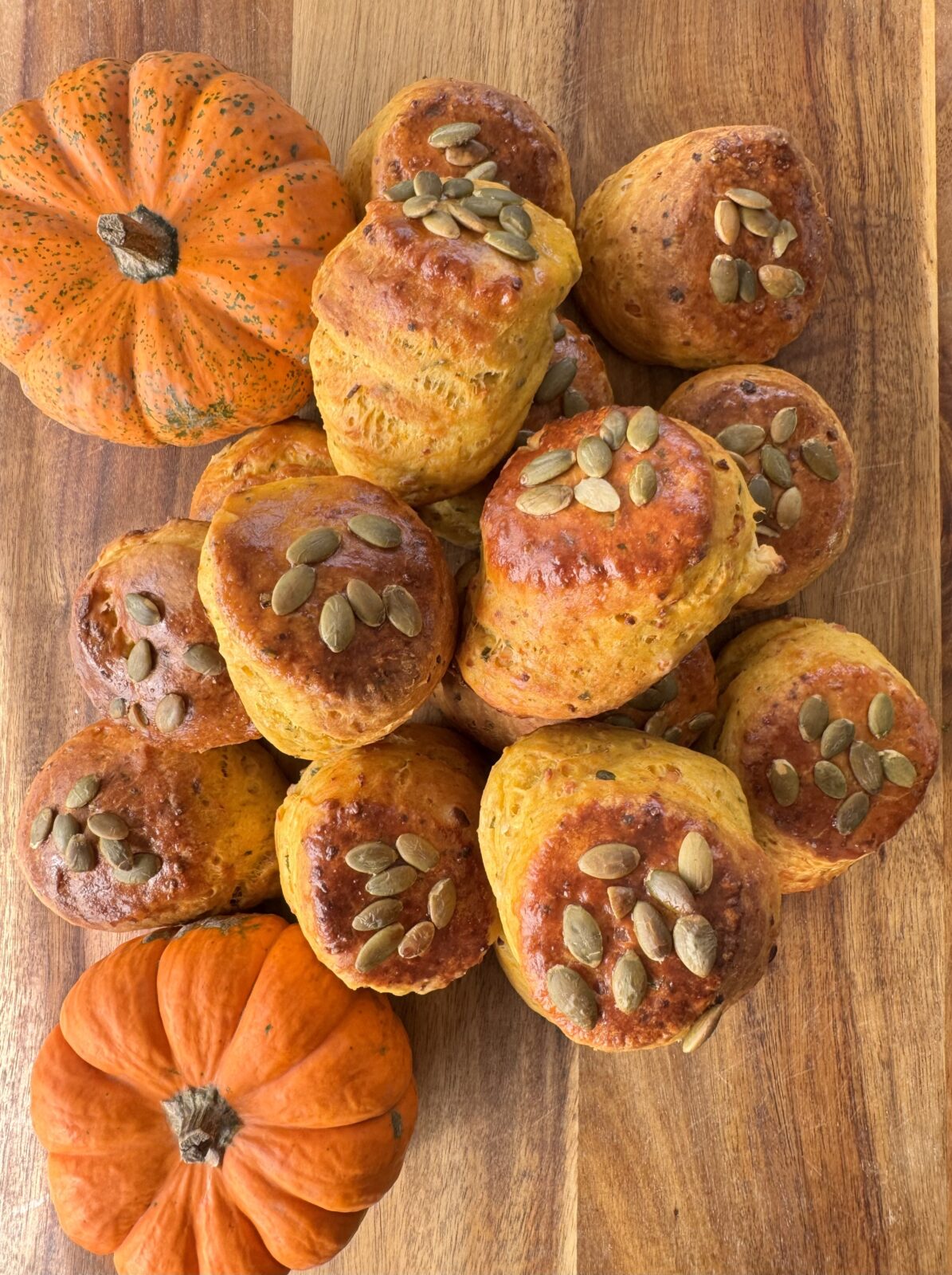
Golden Butternut Squash and Feta Scones with Sage – Autumn Yeasted Scones in 8 Steps
-
Prep Time20 minutes
-
Baking time30 minutes
-
Serving6
-
Total time50 minutes
Golden Butternut Squash Feta Scones with Sage
Author: Tamás Noll – Professional chef in London for 15 years. I teach chefs and conduct cooking classes. Every recipe I share has been prepared and tested by me.
Discover the recipe for golden butternut squash and feta scones with sage and pumpkin seeds. These sweet-salty, flaky, and soft autumn scones are my own recipe that anyone can bake at home.
Autumn has arrived, and the kitchen suddenly exudes a different aroma. Not the scent of summer tomatoes, but that of butternut squash, butter, and a hint of sage. This is how these scones were born.
This is not just another cheesy round. Instead of potato, roasted golden butternut squash goes into the dough, and feta replaces the cottage cheese. The squash is sweet, slightly caramelized, the feta is salty and creamy, and the sage ties it all together. The top is sprinkled with pumpkin seeds, while the inside is flaky and soft, and the crust is crispy.
This is my own recipe. The store didn’t have classic pumpkin, only golden butternut squash, and it turned out better. Its flesh is denser, has less moisture, and is sweeter and nuttier. When you open the oven, the whole apartment smells like autumn. Perfect as a snack, for welcoming guests, or alongside Sunday coffee.
Why This Recipe Works
-
- You roast the butternut squash in its skin, rather than boiling it. This caramelizes it, preventing excess moisture.
- Golden butternut squash is denser than regular watery pumpkin — this gives the dough its structure.
- The feta disperses in the puree, preventing holes in the dough.
- Cold butter + folding (lamination) creates the layers.
- The yeast + refrigerator proofing gives a deeper flavor than quick countertop proofing.
- There’s just enough sage: it’s a background flavor, not overpowering.
- Sour cream adds softness, while the egg provides structure.
Common Mistakes
-
-
- Cooked squash → leads to a watery dough that spreads.
- Warm butter → results in no layers.
- Too much sage → makes it bitter. 7 leaves are sufficient.
- Not folding → results in muffins, not scones.
- Rolling straight from the fridge → causes cracking. Let it rest for 30 minutes.
- Too salty flour → feta is already salty.
-
Pro Tips
-
-
- The butternut squash is good when the edges have started to brown.
- Don’t cube the feta into the dough. Mix it in with the puree.
- Press the pumpkin seeds into the egg wash on top.
- After refrigerator proofing, it’s easier to fold.
- If you can’t find golden butternut squash, regular butternut squash works too. Avoid watery, bland “pumpkin.”
-
Variations
-
-
- Vegan: plant-based feta + plant-based yogurt, use cold margarine instead of butter.
- Spicy: add a pinch of smoked paprika to the squash.
- Cheesier: add 50 g grated cheddar to the feta.
- Mini: use a 4 cm cutter, bake for 18–20 minutes.
-
Tools
-
-
- Baking tray + parchment paper
- Potato masher
- Rolling pin
- 5 cm cutter
-
Storage
-
-
- Best enjoyed fresh and warm.
- In a sealed container for 2 days. Reheat in the oven at 160 °C for 5–6 minutes, do not microwave.
- Can be frozen raw after cutting. Bake from frozen for an additional 3–5 minutes.
-
FAQ
Is butternut squash the same as sonkatök?
Yes. In Hungarian, it’s called sonkatök. Golden butternut squash is a darker, sweeter variety of this.
Can I use regular pumpkin?
Yes, but make sure to drain it well. Butternut squash is denser.
Can I make it without yeast?
Yes, with baking powder (about 10 g), but it won’t be as flaky.
Why 350 g of flour?
At 300 g, it was too sticky with the 180 g of squash puree. At 350 g, it came away from the bowl.
Is folding necessary?
Yes. Without it, the texture will be like a bun.
You can find more fantastic scone recipes by browsing our site further.
Most of our recipes are backed by a small community where we share mistakes, tips, and improvements. If you’d like to join our Facebook page, you can find us here.
Some links on the site may be affiliate links, which could provide us with a small commission at no extra cost to you when you make a purchase.
YOUR RECIPE
Ingredients
Some units use ingredient-specific estimates.
- Butternut Squash and Feta Mixture:
- Dough:
- For Topping:
Directions
Roast the butternut squash. Cut the squash into quarters and scoop out the seeds. Brush with oil, then sprinkle with salt and pepper. Place it skin-side down on a baking tray lined with parchment paper, and roast at 190 °C until the edges are slightly browned and caramelized. It’s done when it’s golden brown, not just soft. Let it cool slightly, then scoop the flesh out of the skin. Measure out 180 g of puree.
Prepare the squash-feta mixture. In a bowl, combine the 180 g of squash puree with 150 g of feta. Mash with a potato masher until you have a roughly smooth puree. Stir in the finely chopped sage, chives, nutmeg, 90 g of sour cream, and 1 egg. Mix thoroughly.
Prepare the flour base. In a large bowl, mix together the 350 g of flour, salt, and 7 g of instant yeast. Cut in the 120 g of ice-cold, diced butter until you achieve a coarse, sandy texture. It’s okay if some butter pieces remain — this is essential for the layers.
Combine the dough. Pour the squash-feta mixture into the flour base and knead until combined. The dough is ready when it pulls away from the sides of the bowl: it shouldn’t stick to your hands, but it shouldn’t be dry and crumbly either. At 300 g of flour, it was still too wet for me; at 350 g, it came together. If it’s still sticky, add 1 tablespoon of flour and work it in.
Proof the dough. Shape the dough into a ball, cover it, and let it rise in a warm place for at least 1–2 hours. For maximum flavor, refrigerate it overnight.
Roll and fold the dough. If the dough has risen in the fridge, take it out and let it sit at room temperature for 30 minutes to make rolling easier. If it has only risen for 1–2 hours in a warm place, you can roll it out immediately. Roll the dough to about 2 cm thick. Fold one half over to the center, then fold the other half over it. This is the lamination process, which creates the flakiness. Repeat this folding process three times, then roll it out again to 2 cm thick.
Cut out the scones. Use a 5 cm cutter to cut out the dough. Brush the tops with beaten egg, sprinkle with pumpkin seeds, and press the seeds in so they don’t fall off. Place them on a baking tray lined with parchment paper.
Bake until golden. Bake in a preheated oven at 190 °C for 25–30 minutes, until they are beautifully golden brown. When you open the oven, the aroma of sage and caramelized butternut squash will fill the kitchen.
Nutrition
Nutritional content per serving:
- Daily Value*
-
Calories 245 kcal12 %
-
Fat 13 g19 %
-
of which saturated fat 8 g40 %
-
Carbohydrates 24 g9 %
-
Sugar 2 g2 %
-
Fiber 1.5 g6 %
-
Protein 6 g12 %
-
Salt 0.5 g8 %
- We calculated the nutritional values based on the daily requirement of an average adult of 2000 kcal.



Leave a Review