


Ma sem halunk éhen · Recipes
Traditional Tarhonya with Meat

-
Prep Time25 minutes
-
Serving8
-
Total time70 minutes
Traditional Tarhonya with Meat – Homestyle Recipe with Pork Leg
Author: sendrew
I only cook at home, but tarhonya with meat is one of those dishes that is hard to mess up if you follow a few simple rules. The traditional tarhonya with meat is made from pork leg, and when mixed with a tomato stew, it becomes a truly hearty one-pot meal.
What is particularly important to me in this recipe is the toasting of the tarhonya. It requires a bit of attention, as it can easily burn, but if it turns a nice golden brown, it greatly enhances the flavor of the dish right from the start.
Why Does This Recipe Work?
Toasted tarhonya makes a significant difference. We don’t just cook the pasta; we toast it first, which gives it the distinctive flavor that we love in this dish.
Pork leg pairs well with the stew. Cut into cubes and cooked slowly, it will become tender and absorb the onion-tomato sauce well.
Onion and garlic provide the base. There’s no need to overcomplicate the seasoning. Cumin and pepper are just enough to give it a homely flavor.
The tarhonya absorbs the sauce at the end. If the dish seems a bit too wet when mixed, there’s no need to worry immediately. The tarhonya will soak up some of the liquid as it sits.
Tools
A pot for toasting and pre-cooking the tarhonya
A larger pot for the stew and mixing
Cutting board and knife for preparing the meat, onion, and garlic
Lid for cooking the tarhonya and stew
If you don’t have two separate pots, you can first prepare the tarhonya in one pot and set it aside while the stew cooks. This way, you can use the same larger pot, but it requires a bit more attention.
Common Mistakes
1. The tarhonya burns while toasting.
This can easily happen, especially if you’re distracted by something else. Stir continuously, and when it reaches a golden brown color, don’t wait any longer to add the water.
2. The pork becomes tough or dry.
Pork leg needs time. Cook it covered, adding a little water if necessary, until it becomes tender. Don’t just watch the clock; pay attention to the texture of the meat.
3. The stew becomes too thick.
If the liquid evaporates during cooking, add a little water. It’s better to add in smaller amounts, making it easier to achieve the right sauciness.
4. Too much sauce remains after mixing.
The tarhonya can still absorb some moisture, so don’t try to cook it completely dry right away. Wait a few minutes and then decide if it needs further thickening.
Pro Tips
Stay by the stove while toasting the tarhonya. This is one part of the recipe where a few minutes of distraction can show in the final result.
Cut the meat into similarly sized cubes. Pieces about 2 × 2 cm will cook more evenly, so one bite won’t be done long before another.
Add water gradually. The stew needs some sauce, but it shouldn’t be too watery. It’s easier to control during cooking than at the end.
Don’t judge the texture all at once. The mixed tarhonya with meat can change in a few minutes, as the tarhonya continues to absorb the liquid.
Variations
1. Tarhonya with Chicken
If you want a lighter meat version, you can use chicken leg instead of pork leg. Adjust the cooking time according to the size of the meat and when it becomes tender.
2. Vegetable Tarhonya with Meat
You can add small amounts of diced bell pepper or carrot to the stew. This deviates from the original recipe, but it’s a good option if you want to add vegetables to the dish.
Cooling and Storage
If there are leftovers from the tarhonya with meat, let it cool enough to safely store in the refrigerator, but don’t leave it at room temperature for long hours. Place it in well-sealed containers, preferably divided into smaller portions.
In the refrigerator, it can generally be kept for 3–4 days at a maximum of 4 °C. If you know it won’t be consumed within that time, freeze it as soon as possible.
For freezing, use well-sealed containers and label them with the date. It’s best to consume it within 2–3 months for optimal quality. After thawing, the tarhonya may be softer and slightly denser as it absorbs moisture.
Reheating
The simplest method is in a skillet or pot. Add a little water to the dish and heat it over low to medium heat, stirring frequently. This way, the tarhonya will dry out less.
It also works in the microwave: place a portion in a microwave-safe container, add a little water, and heat on medium or high power for 1–2 minutes. Stir and if it’s not hot all the way through, continue in short intervals.
For larger quantities, the pot is more practical, as it’s easier to heat evenly. When reheating, ensure the entire dish is thoroughly hot; avoid reheating the already warmed leftovers multiple times.
FAQ
What meat is used for traditional tarhonya with meat?
In this recipe, the stew is made from pork leg. The meat is cut into approximately 2 × 2 cm cubes and added to the onion base.
Why should the tarhonya be toasted?
Toasting gives the tarhonya its distinctive flavor and golden brown color. It must be stirred continuously, as it can easily burn.
Can it be prepared in advance?
Yes. Stored in the refrigerator, it can be consumed later, and you can restore its moisture by adding a little water when reheating.
Summary
Traditional tarhonya with meat is not a complicated dish; you just need to pay attention while toasting the tarhonya and cooking the stew. What I like about it is that the meat and the side dish come together as a single hearty meal, and served with pickles, you don’t really need anything else. If there are leftovers for the next day, reheating is not a big deal – just don’t forget to add a little water.
You can find more fantastic recipes by browsing our site. Most of our recipes are backed by a small community where we share mistakes, tips, and improvements.
If you want to join our Facebook page, you can find us here. Share with us how your tarhonya turned out!
YOUR RECIPE
Ingredients
Some units use ingredient-specific estimates.
- For the Stew
- For the Tarhonya
Directions
Pour 50 ml of oil into a pot and start toasting the tarhonya. Continuous stirring is necessary, as it can easily burn. When it turns golden brown, pour in 500 ml of boiling water, add a teaspoon of salt, and cover. After 10 minutes, stir, and if needed, you can add another 100 ml of hot water, mix, and cover again. Let it soften.
Pour 50 ml of oil into the pot and start to sauté the chopped onion. When it starts to become translucent, season lightly with salt and pour in 50 ml of water. While it evaporates, chop the garlic finely and add it. When the aroma of garlic comes, sprinkle the paprika over it and stir. Note: Do not sauté the garlic for too long, as it can easily burn. Also, quickly mix in the paprika to avoid burning.
Add the previously cleaned and cubed pork leg (2x2 cm) to the onion with paprika. Stir until the meat turns white, then pour in the tomato paste. Season with salt and pepper, and add the ground cumin. Cover and cook the stew until tender, adding 100 ml of water if needed. It should become tender in about 40 minutes. I wouldn't rush the cooking. Check occasionally, and if the sauce thickens too much, add a little water.
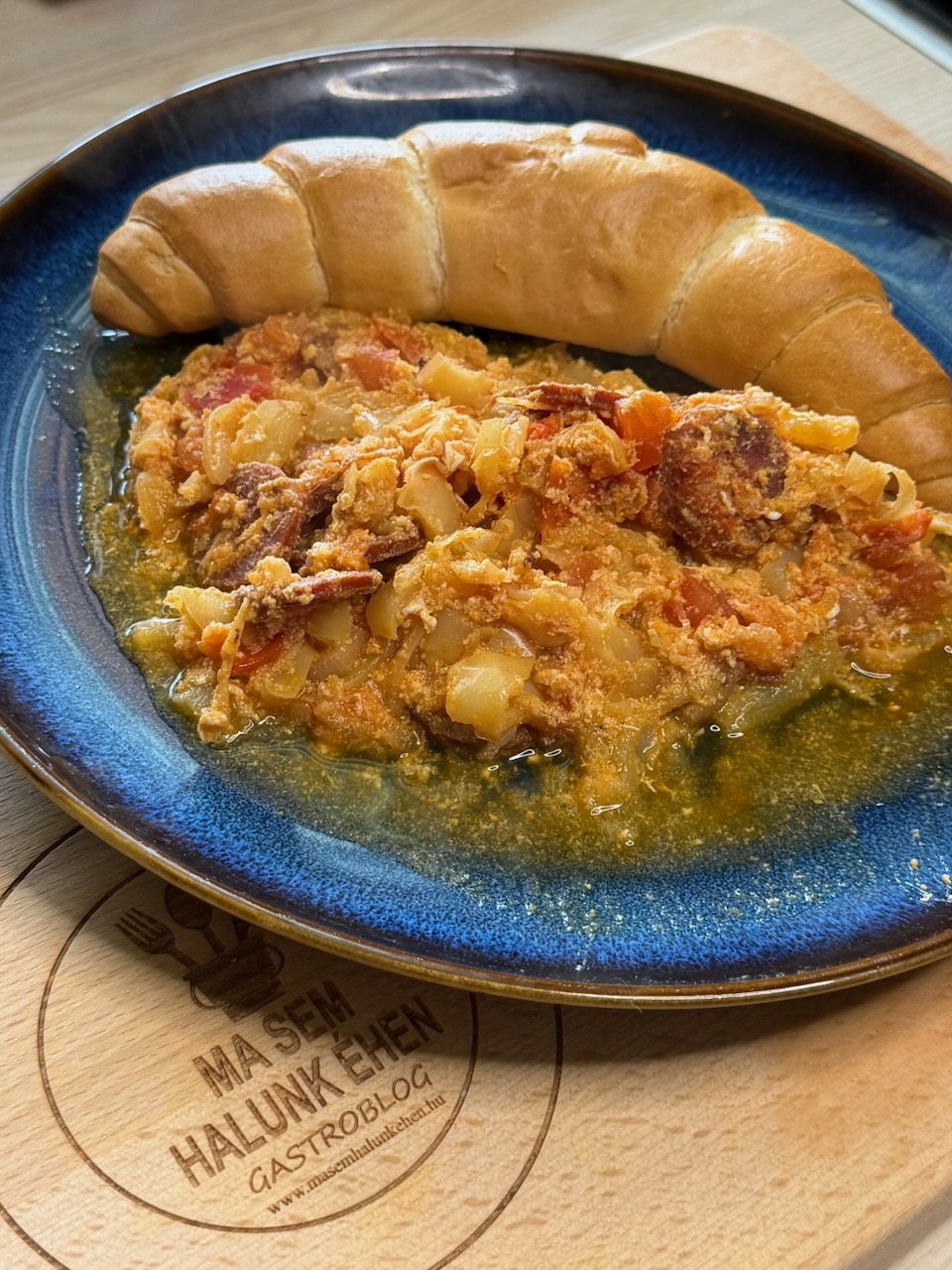
Mix the finished stew with the tarhonya in a pot. If it seems a bit saucy at first, don't worry, as the tarhonya will absorb the moisture. Small note: after mixing, it's worth waiting a few minutes before serving to see how much sauce the tarhonya has absorbed. Serve with pickles.
Nutrition
Serving size: approximately 320–400 g, estimated as 1/10 of the total prepared dish.
- Daily Value*
-
Energy ~736kcal27%
-
Fat ~30.4g43%
-
of which saturated fat ~8g40%
-
Carbohydrates ~83.2g32%
-
of which sugar ~8g9%
-
Protein ~32g64%
-
Fiber ~4.8g19%
-
Salt ~0.8 g13%
- The values are based on the daily requirement of an average adult of 2000 kcal.



Leave a Review