


Ma sem halunk éhen · Recipes
Light and Fluffy Cottage Cheese Dumplings
-
Prep Time20 minutes
-
Serving6
-
Total time60 minutes
Light and Fluffy Cottage Cheese Dumplings
One of the greatest paradoxes of Hungarian cuisine is the cottage cheese dumpling. At first glance, it seems like the simplest folk dessert, yet few can prepare it perfectly. It can either turn out as hard as a bowling ball or fall apart in water like soap. However, when we get the ratios and technique right, we create a light, almost melt-in-your-mouth wonder, crowned with the smoothness of sweet, powdered sour cream.
Where Did Cottage Cheese Dumplings Come From?
Although we tend to consider it a quintessential Hungarian dish, the roots of cottage cheese dumplings trace back to the shared culinary heritage of the former Austro-Hungarian Empire. In Austria and Bavaria, they are known as Topfenknödel, and they are one of the best examples of fusion cuisine from the monarchy.
The original Austrian version is often based on a buttery dough or enriched with breadcrumbs, while the local cuisine has adapted it to its own taste: here, the combination of semolina and high-quality crumbly cottage cheese brought about the real breakthrough. Cottage cheese dumplings are not a refined creation of noble kitchens but rather an invention of frugal rural households: transforming a few inexpensive ingredients into something filling, nutritious, and delicious.
Why Does This Recipe Work?
- Hydration and Resting of Semolina: The starch granules in semolina cannot absorb moisture immediately. If you cook it right after mixing, the semolina will remain hard, and the dumpling will fall apart. During the resting period (at least half an hour, but the best results come from overnight resting), the semolina slowly absorbs the moisture from the cottage cheese and eggs, swells, and forms a cohesive yet soft structure.
- The Protein Network: The proteins in the eggs and cottage cheese coagulate (solidify) under heat. This gives the dumpling its structure. If there is too much semolina or egg, the texture will become too dense and rubbery.
- The Toasted Breadcrumbs: Breadcrumbs toasted dry or in a little butter/oil until golden brown acquire a nutty, roasted aroma thanks to the Maillard reaction. This crispy, warm layer creates a perfect contrast to the soft, tangy cottage cheese inside.
Where Can It Go Wrong?
Insufficient Resting Time: If you are in a hurry, the semolina won’t absorb enough moisture, and the dumpling will fall apart in the simmering water.
Cooking in Boiling Water: Cottage cheese dumplings should never be cooked in violently boiling water! The physical force of the boiling water will simply break apart the delicate dough. Bring the water to a boil, then reduce the heat so it just simmers.
Dry, Crumbly Cottage Cheese Without Pressing (or Conversely: Too Watery Cottage Cheese): Store-bought watery, creamy cottage cheeses will overly dilute the dough. Good quality, semi-fat crumbly cottage cheese is best, but be sure to mash it well with a fork to avoid large, hard lumps.
Adding Too Much Flour/Semolina: Many people get scared that the mixed batter is too soft. Don’t make the mistake of adding more semolina! During the resting period, the semolina will absorb the liquid and firm up.
Art of Serving
The Sour Cream Sauce: Mix cold, high-fat (20%) sour cream with powdered sugar and a pinch of real bourbon vanilla or vanilla sugar. The contrast in temperature and flavor between the cold, sweet-sour sour cream and the hot, crispy dumplings is what makes it truly special.
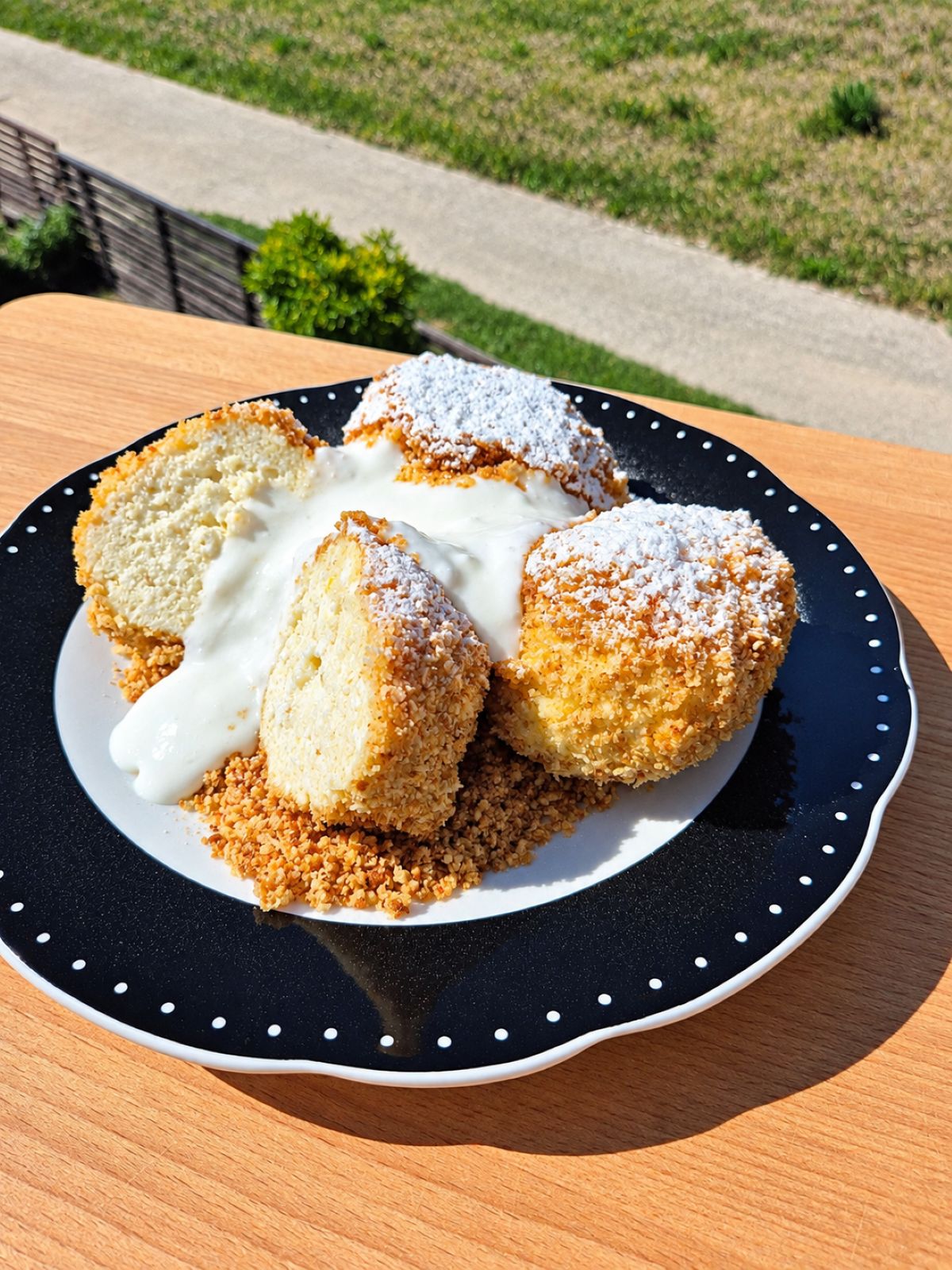
Serving Tip: Place a generous amount of the sweet vanilla sour cream on the bottom of the plate, then add 3 warm dumplings that have been rolled in breadcrumbs on top, and finally, dust a little more powdered sugar over them. You can garnish with a sprig of fresh mint or a few fresh berries for a pop of color.
Storage, Freezing, and Reheating
Storage
The cooked and breadcrumb-coated dumplings can be stored in an airtight container in the refrigerator for 2-3 days. Always store the sour cream sauce separately.
Freezing
Cottage cheese dumplings freeze excellently, but only when raw!
- Shape the dumplings from the rested mixture.
- Place them spaced apart on a tray or cutting board lined with baking paper.
- Put the tray in the freezer for 2-3 hours (pre-freezing).
- Once they are frozen solid, transfer them to a freezer bag. This way, they won’t stick together. They can last for up to 3 months.
Cooking After Freezing: Do not thaw them! Drop the frozen dumplings directly into gently simmering, slightly salted water. The cooking time will be 3-4 minutes longer than for fresh dumplings.
Reheating
In the Microwave: Heat only on low power (400-500W), covered, otherwise the inside of the dumplings may become rubbery, and the breadcrumbs will soften.
Variations on a Theme
Once you have mastered the basic recipe, it’s worth experimenting with textures and flavors:
Stuffed Dumplings: Hide a pitted cherry, a piece of dark chocolate, a raspberry, or a teaspoon of thick plum jam in the center of the dumpling while shaping.
Nutty Breadcrumbs: Replace half of the traditional breadcrumbs with finely ground roasted hazelnuts, walnuts, or almonds.
Poppy Seed Version: Instead of breadcrumbs, roll the dumplings in ground, powdered poppy seeds, and serve with a cherry sauce.
Austrian Cottage Cheese Dumplings: In this version, instead of semolina, stale bread crust or butter and flour are used for the base mixture, resulting in an even creamier, almost mousse-like texture.
For more fantastic treat recipes, keep browsing our site.
Most of our recipes are backed by a small community where we share mistakes, tips, and improvements. If you would like to join our Facebook page, you can find us here.
Some links on the site may be affiliate links, which could provide us with a small commission if you make a purchase, at no extra cost to you.
YOUR RECIPE
Ingredients
Some units use ingredient-specific estimates.
Directions
Mix the cottage cheese, eggs, and semolina with 3 tablespoons of sugar and a pinch of salt. I used a food processor, which helped break down the cottage cheese lumps. Grate in the lemon zest, then refrigerate for at least half an hour to allow the semolina to absorb moisture.
While the mixture rests in the refrigerator, start to toast a cup of breadcrumbs in a high-sided pan over medium heat. Add half a deciliter of oil. Sprinkle in 3 tablespoons of sugar and a pinch of salt. Stir continuously to prevent burning. It’s done when it turns a nice golden brown and you can smell the aroma.
Bring a pot of water to a boil and season with salt. Remove the mixture from the refrigerator. With wet hands, shape it into balls about 4-5 cm in diameter and place them in the gently simmering water. Cook the dumplings until they float to the surface. At that point, remove them and roll them in the crispy breadcrumbs.
Before serving, mix the sour cream with a few tablespoons of sugar. We counted 3 dumplings as one serving, which is quite filling despite the lightness of the dumplings.
Nutrition
Contents of one serving:
- Daily Value*
-
Calories 615 kcal31%
-
Protein 39.6 g79%
-
Fat 29.5 g42%
-
of which saturated fat 16.8 g84%
-
Carbohydrates 46.1 g18%
-
of which sugars 21.5 g24%
-
Salt 0.25 g4%
- The values are based on an average adult's daily requirement of 2000 kcal. We counted 3 dumplings as one serving.




Leave a Review